The short version
Both pages were re-captured today, 2026-09-24, for this comparison — Framer in two fetch stacks (screenshot in the page’s own default currency, price text from a second request), Carrd via the full-DOM plan dump. This is a terms comparison: we did not build a site in either tool, so there is no star rating on either side.
Headline numbers, as the pages print them today:
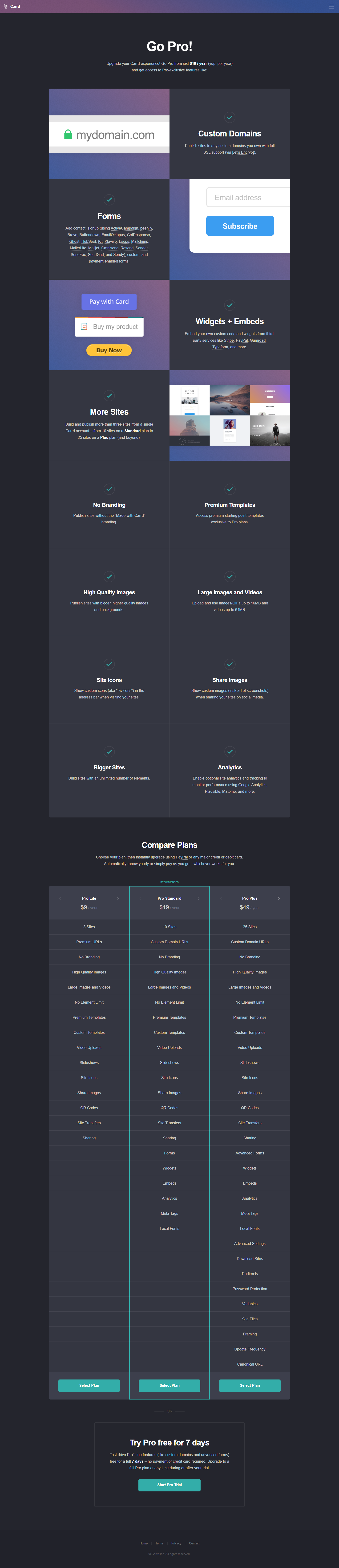
| Carrd | Framer | |
|---|---|---|
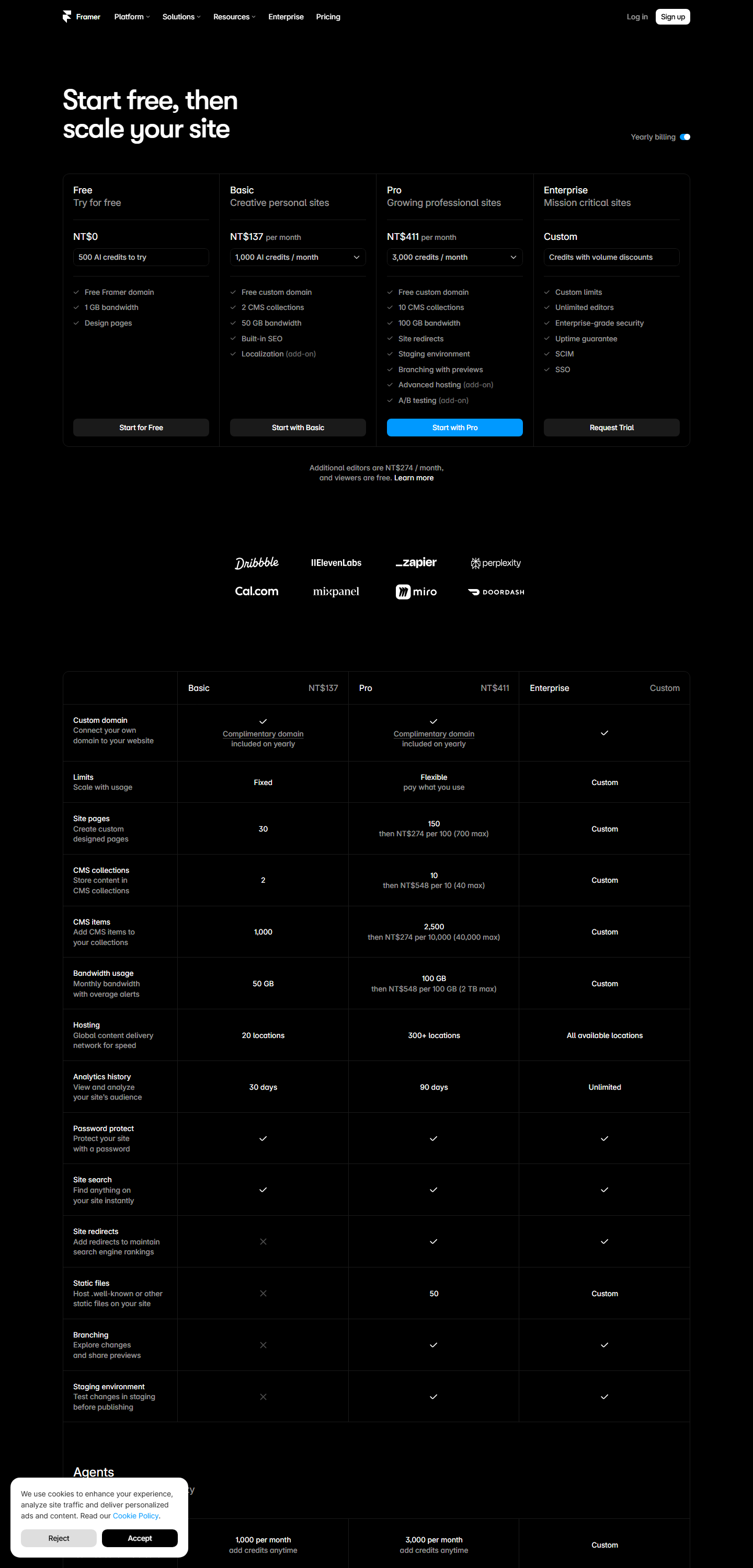
| Free tier | 3 sites, core features included | $0 — Framer subdomain, 1 GB bandwidth, 500 trial AI credits |
| Cheapest paid | Pro Lite $9/year (3 sites) | Basic $10/month per site, billed yearly |
| Custom domain on cheapest tier | ❌ (Standard and up) | ✅ (custom domain free on Basic) |
| “Real” entry for a custom-domain site | Pro Standard $19/year (10 sites) | $120/year ($10 × 12) |
| Billing cycle options | Annual only | Yearly (the page renders “Yearly billing”; monthly carries the same numbers — see Framer pricing check) |
| What the unit is | per account, sized by site count (10 → 1,000 sites) | per site, plus per-person editor seats |
The $19-vs-$120 gap is real, but the unit difference is the part most comparisons skip: Carrd’s $19 buys a bucket of ten sites; Framer’s $120 buys exactly one. At the 10-site end, Carrd’s Standard ladder still tops out at $599/yr while Framer would be $1,200.
The currency trap is alive on both sides — and today it speaks New Taiwan Dollars
Our 2026-09-10 Framer capture rendered Japanese yen by default (Basic ¥1,540); today the same headless route rendered NT$137 / NT$411 — the page’s default currency follows the exit location of whoever is fetching it, and the control to change it is not visible to a text-only reader. The structural cross-check still works: NT$137 ÷ $10 = NT$411 ÷ $30 = 13.7, a single consistent TWD/USD rate across both cards, and a second request stack in the same hour returned the USD text layer directly (Basic $10, Pro $30, “Yearly billing”). Both numbers in the table above are the USD ones; the NT$ screenshot sits in the evidence panel as the honest record of what the page showed our browser.
Carrd has the opposite problem: US dollars are the only currency — the entire ladder is annual
USD, printed as /yr amounts ($9–$999 across 16 SKUs, re-dumped intact today, zero drift against
our Carrd capture of 2026-09-21). If a Framer price you read anywhere looks
odd, check which currency the reader’s exit IP was in; if a Carrd price looks odd, check whether
the writer divided a yearly figure by 12 and dropped that it was never a monthly plan.
What the extra $101 actually buys
Held to their own pages, the two entry-adjacent plans (Carrd Standard, $19/yr for 10 sites; Framer Basic, $10/mo per site) differ less in “features” than in kind of product:
- Carrd Standard: custom domain URLs, forms, widgets, analytics and meta tags on every site in the bucket — a one-page-site builder whose ceiling is visible and flat. The $10 step from Pro Lite ($9) to Standard ($19) is exactly custom domains plus forms (item-by-item diff in our Carrd pricing check).
- Framer Basic: CMS collections (2), 50 GB bandwidth, built-in SEO, and a credit-metered AI layer — but a site meter, so a second site is a second $120. Editor seats beyond the included one are add-ons ($20/mo per editor on the page we captured 2026-09-10).
If you need one marketing site with a blog, neither plan is comparable price-to-price: Framer is selling a CMS, Carrd is selling a page. If you need ten landing pages, Carrd’s bucket model is roughly 6x cheaper ($19 vs ~$1,200) and the ladder scales to 1,000 sites at $599/yr — a quantity Framer’s per-site model never tries to serve at that price.
Where each page hides its real cost
- Framer: the AI credits row. Both cards print a credit dropdown (1,000 → 15,000 credits/month on Basic today); the included allowance is the bottom option, and everything above it is an add-on ladder living inside the plan card. Bandwidth overages and localization are add-ons too.
- Carrd: the annual-only rule. Every price above is per year, and there is no monthly escape hatch — the flip side is that a forgotten subscription costs $19, not $240. Free tier sites carry a “Made with Carrd” label until Standard.
Verdict (terms-level, no score)
Neither page contradicted itself today, and neither price moved since our September captures — which is the most useful thing this comparison can report. Choose Carrd if the job is many small sites and $19/yr per bucket of ten is the budget; choose Framer if the job is one serious site with CMS and design tooling and $120/yr per site is the floor. Comparing them on price at all is only valid at the “one custom-domain page” point — beyond that they are different products with different meters. We did not build in either, so treat every claim here as page-terms, not hands-on.
Methodology & sources
- framer.com/pricing — captured 2026-09-24 (UTC) twice: headless browser screenshot in the page’s default NT$ state (evidence above), plus a proxied request returning the USD text layer (Basic $10 / Pro $30 / “Yearly billing”, editor and add-on prices unchanged from 2026-09-10). Rate-structure cross-check 137÷10 = 411÷30 = 13.7 documented above.
- carrd.com/pro — captured 2026-09-24 (UTC) via full-DOM text dump in one proxied browser session
(the plan carousel hides high rungs from
innerText; the whole 16-SKU ladder $9–$999 is in the document text). Zero drift vs our 2026-09-21 capture. Note the site now serves from carrd.com. - Baseline captures this page re-verifies: Framer terms check (2026-09-10), Carrd terms check (2026-09-21), Framer vs Webflow (2026-09-13).
- Arithmetic marked as ours (not printed by either vendor): the $120/yr = $10 × 12 conversions and the 13.7 rate check.
- Checked 2026-09-24. Pricing pages change; re-verify before citing.