The short version
This comparison is built from both vendors’ official pricing pages, each captured in a live proxied browser session: n8n on 2026-09-16 (both billing states exercised) and Zapier on 2026-09-15 (both billing states + the pay-per-task help article; full breakdown in our Zapier terms check). It is a terms comparison, not a hands-on test: we did not build a workflow on either platform.
The two tools look comparable on price and are not comparable on units:
- n8n charges per workflow execution; Zapier charges per task (= step). n8n’s page states the rule in its own words: pricing is “based on monthly workflow executions, regardless of complexity” and “Pay for full executions, not for each step”. On Zapier, a 5-step Zap burns 5 tasks per run. So Zapier’s “100 tasks” and n8n’s “2.5k executions” measure different things — on a 5-step workflow, 100 Zapier tasks is 20 runs, while 2,500 n8n executions is 2,500 runs.
- The free layer is structurally different. Zapier has a real free hosted plan ($0, 100 tasks/month, two-step Zaps only). n8n Cloud has no free tier at all — the page’s lowest button is a trial (“No credit card required”) — because n8n’s free layer is the self-hosted Community Edition: the entire product is source-available on GitHub under the Sustainable Use License — fair-code, not OSI open source (~205.5k stars, API-verified 2026-09-21), free forever if you run your own server.
- The yearly-discount claims are honest on both sides — but the monthly uplifts differ. Zapier’s “Save 33%” label reconciles exactly ($19.99 → $29.99 is +50% monthly), and n8n’s “Annually (Save 17%)” reconciles exactly too (€20 → €24 and €50 → €60 are +20% monthly; 1 − 20/24 = 16.7%). Both labels survive arithmetic — rare in this matrix, where we’ve caught ClickUp’s “up to 30%” overshooting at 36.8% and Jotform’s “up to 20%” landing at 12.8%.
Pricing side by side
| n8n Cloud (captured 2026-09-16) | Zapier (captured 2026-09-15) | |
|---|---|---|
| Billing unit | 1 workflow execution = 1 full run, any number of steps | 1 task = 1 step (a 2-step Zap = 2 tasks per run) |
| Free hosted plan | none — trial only (“No credit card required”) | $0, 100 tasks/month, two-step Zaps only |
| Free self-host | Community Edition on GitHub, Sustainable Use License (fair-code) | not available |
| Entry paid | Starter €20/mo yearly (€24 monthly) — 2.5k executions, 5 concurrent, unlimited users | Professional from $19.99/mo yearly ($29.99 monthly) — multi-step Zaps, 750 tasks base (secondary source, see note) |
| Next tier | Pro €50/€60 — 10k executions, 20 concurrent | Team from $69/$103.50 — up to 25 users, SAML SSO |
| Top tiers | Business €667/€800 (self-hosted, 40k executions), Enterprise custom | Enterprise custom |
| Monthly uplift | +20% (both states captured) | +50% (both states captured) |
| Yearly label | “Save 17%” — arithmetic checks out | “Save 33%” — arithmetic checks out |
| Users | unlimited on every plan | Free/Professional single-user; 25 users needs Team |
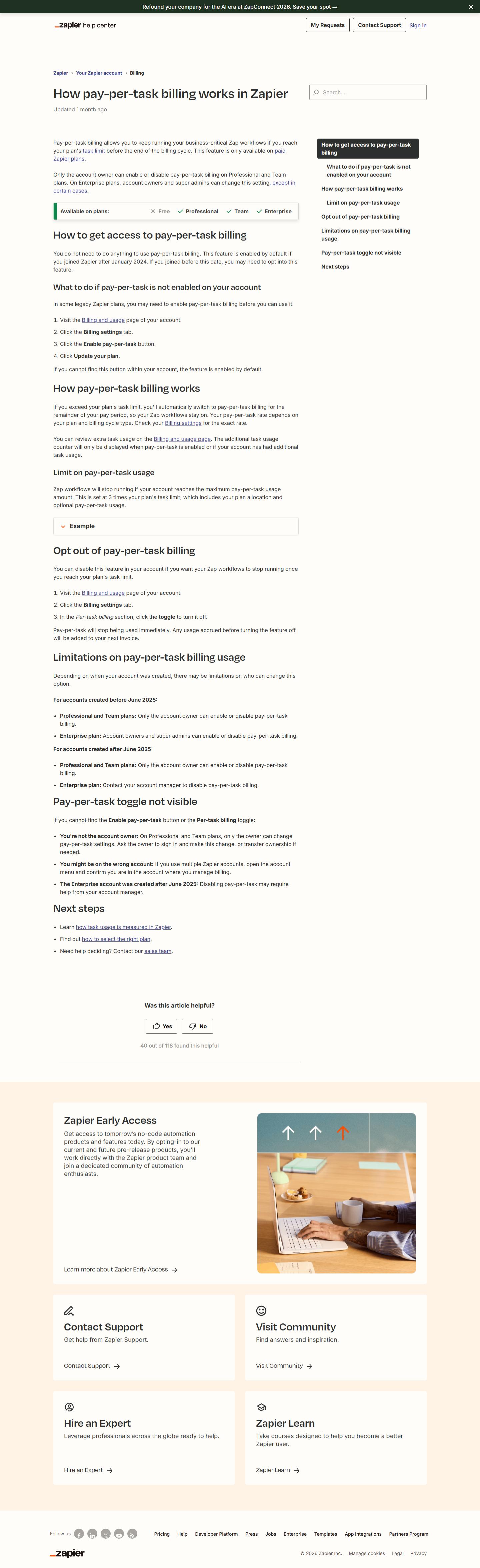
| Overage behavior | not printed on the pricing page (not verified) | auto-switch to pay-per-task unless turned off, capped at 3x plan limit |
The currency catch: n8n showed us euros, and no way to switch
Our capture rendered every n8n price in euros (€20 / €24 / €50 / €60 / €667 / €800), and a programmatic sweep of the page found no currency control at all in the DOM — unlike Zapier, whose pricing page carries an explicit “USD ($)” selector. This is the same geo-default behavior we documented on Figma (defaults to yen) and Brevo / Mailchimp (jpy defaults, manually switched for evidence). We did not attempt to spoof a US location, so all n8n amounts in this article are stated in euros, as the page printed them — we are not converting them to dollars.
Does that break the comparison? Not for the structural points: the €20 vs €24 uplift arithmetic is same-currency and exact, and the per-execution vs per-task unit difference is currency- independent. But anyone pasting n8n’s “Starter” price into a budget spreadsheet should re-open the page from their own location and read the currency symbol before writing a number down.
Where each bill actually starts
Zapier’s cost story is step inflation. The free plan’s 100 tasks look workable until you notice a task is a step: a 4-step Zap running 25 times a month is already at the wall. Paid plans bill the same way, which is why the pay-per-task overage switch (on by default, per the help article) surprises multi-step users. One 2026 clarification works in Zapier’s favor: Zaps, AI steps, code, and MCP now draw from one shared task pool — predictable after the merge, but it means AI features consume the same finite currency as plain automations.
n8n’s cost story is run volume, with a hidden skill tax. 2.5k executions per month on the €20 Starter is a genuinely larger automation budget for multi-step flows — a 10-step workflow costs the same 1 execution as a 2-step one. But n8n Cloud’s entry tier also caps you at 1 shared project and 5 concurrent executions, and the free self-host route shifts server maintenance, updates, and uptime to you. The “unlimited users on all plans” line is the anti-Zapier shot: Zapier needs Team ($69+) before collaboration is on the menu.
Which math fits you: if your automations are short (trigger → one action), Zapier’s per-task unit barely punishes you and its free tier covers hobby volume with zero setup. If they are long chains (fetch → filter → enrich → write to three places), the per-step vs per-run difference compounds in n8n’s favor — provided the self-host/no-free-cloud tradeoff suits you.
What we did not verify
- Neither platform was operated: no Zap built, no workflow run, no account created. Every number above is page-printed text captured in the stated states, no screenshots-of-images reading.
- n8n’s USD price list — our session could not render one (see above). If the euro and dollar lists differ by more than symbol swap, that divergence lives outside this article’s evidence.
- n8n’s overage behavior when a plan’s execution limit is crossed (not stated on the pricing page).
- Zapier’s 750-task Professional base figure — it does not appear on the pricing card; it comes from third-party trackers and is carried here only as a secondary cross-check, flagged the same way as in the Zapier terms check.
- The Community Edition feature delta vs paid tiers (the pricing page mentions “all core features” for self-hosting; we did not diff it against the docs).
Methodology & sources
- n8n pricing page — Playwright capture 2026-09-16, yearly (default) and monthly states,
full-page screenshots + text-layer extraction (runId
2026-09-16-n8n-pricing, eval-ops/runs/). GitHub stars pulled same day via GitHub API. - Zapier pricing page + help.zapier.com pay-per-task article — Playwright captures 2026-09-15
(runId
2026-09-15-zapier-pricing), evidence shared with our Zapier terms check. - Pricing figures age fast in this category; re-verify against both live pages before quoting.
For the wider field — including Activepieces and the licensing fine print on self-hosted Windmill — see n8n alternatives.