The short version
Both pricing pages were read in USD from a US-locale session on October 6, 2026. No accounts were created on either platform and no plan was purchased — this is a terms comparison, not a test run.
Zapier sells tasks. Make sells credits. On paper both units mean the same thing — one successful action inside an automation — but only one of the two vendors prints a price you can divide.
Pricing side by side
| Zapier | Make | |
|---|---|---|
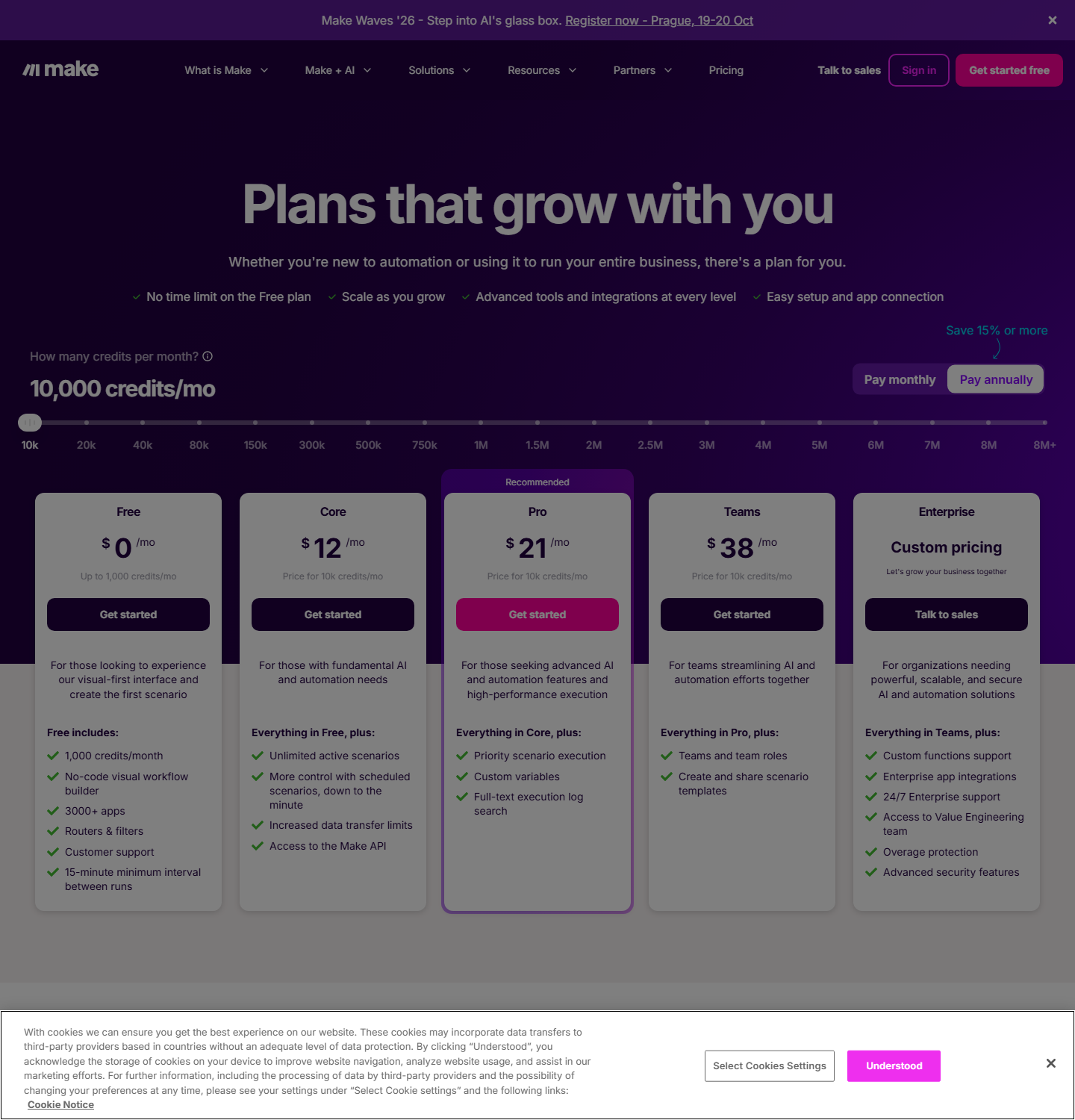
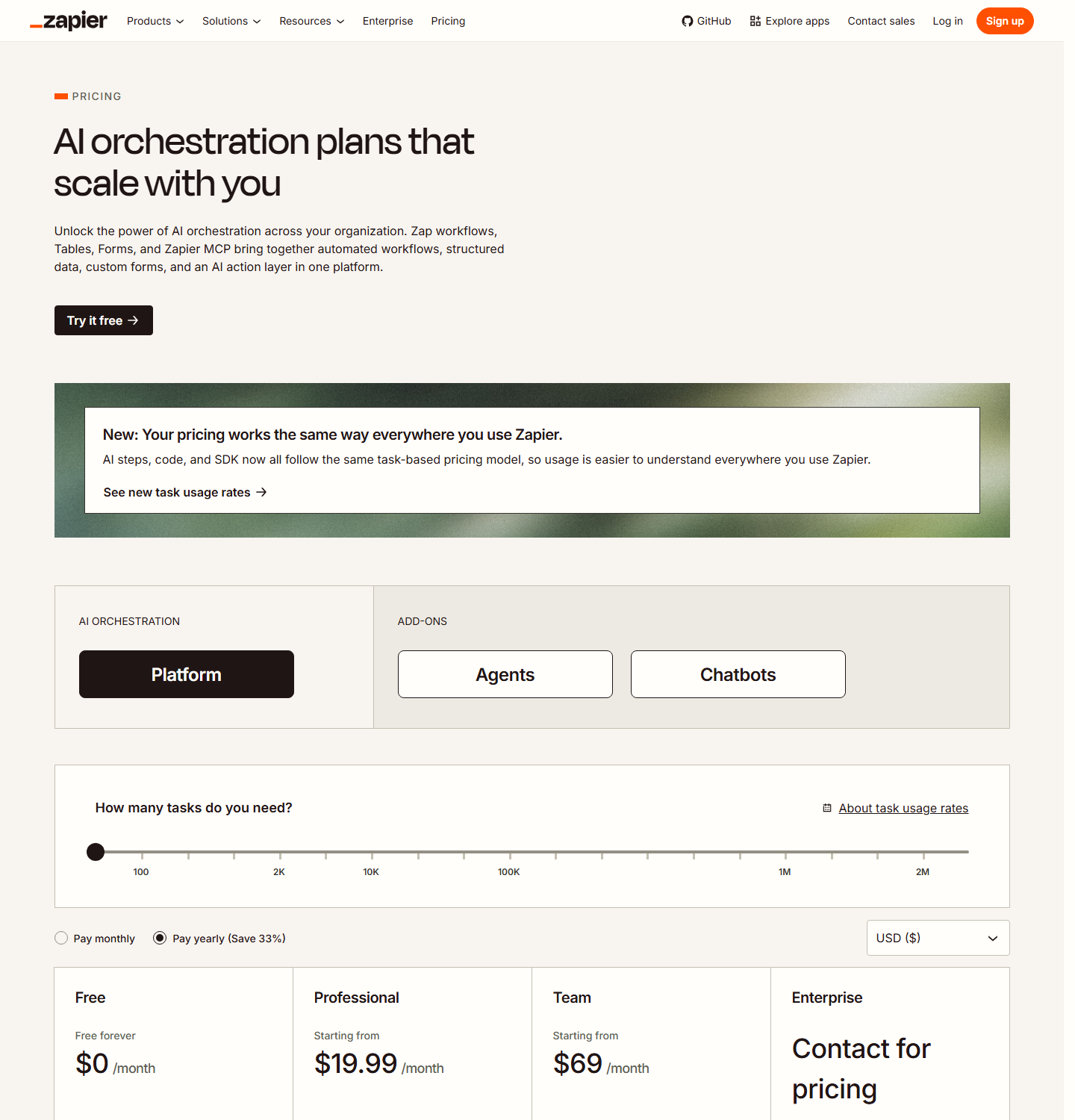
| Free | $0/month, “Free forever” | $0/month, up to 1,000 credits/mo, no time limit |
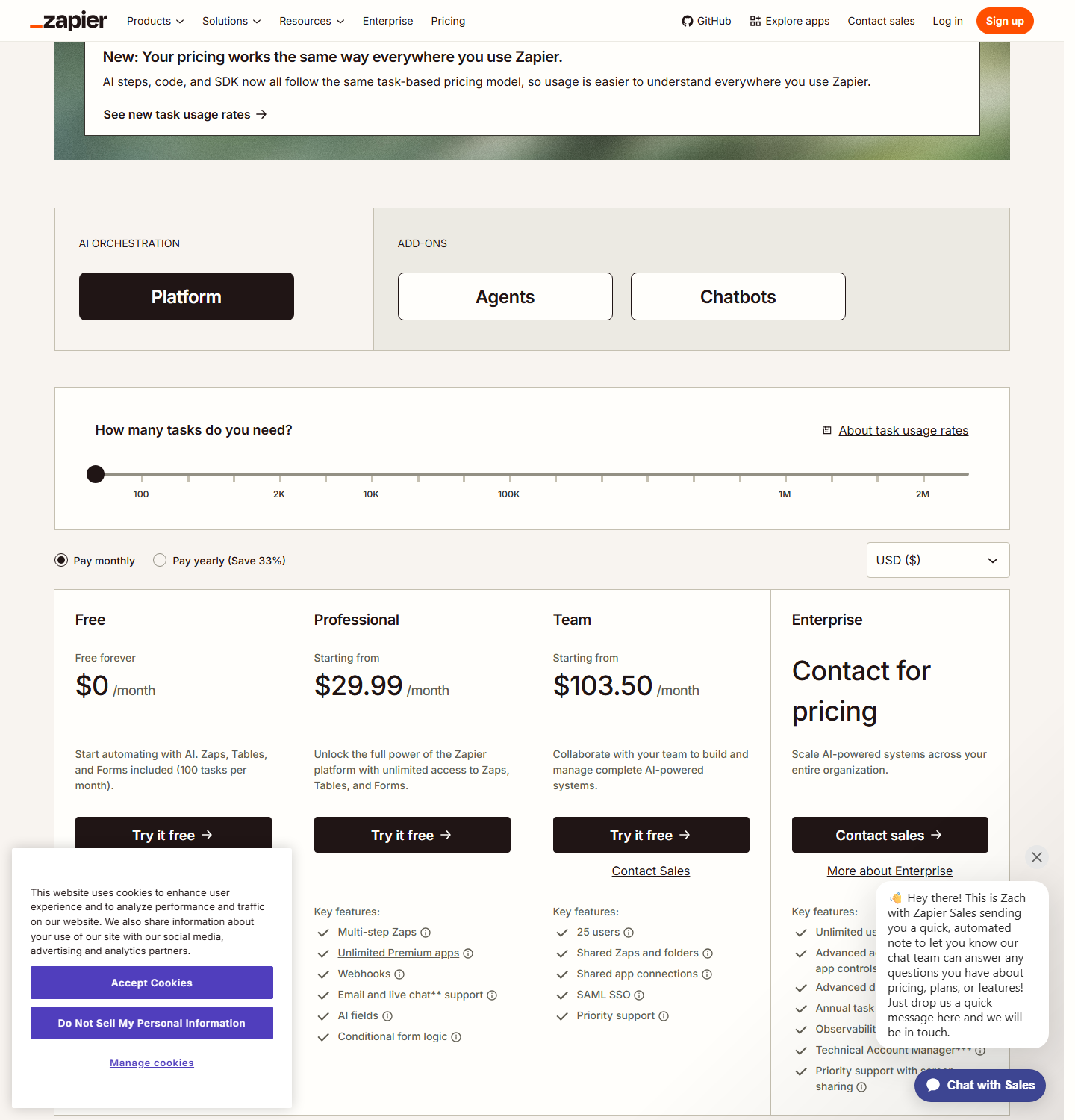
| Entry paid | Professional from $19.99/mo yearly · $29.99 monthly | Core $12/mo for 10,000 credits/mo |
| Mid tier | Team from $69/mo yearly · $103.50 monthly | Pro $21/mo for 10,000 credits/mo |
| Upper tier | Enterprise — contact for pricing | Teams $38/mo for 10,000 credits/mo; Enterprise custom |
| Usage unit | one task per successful action | one credit per module action |
| Scale control | task slider, 100 → 2M | credit slider, 10k → 8M+ |
| Annual claim on the page | “Pay yearly (Save 33%)” | “Save 15% or more” |
| Currency selector | USD ($) printed | USD session (no selector shown) |
Where the two pages stop being comparable
Make prices the unit; Zapier prices the seat. Every Make paid card carries the line “Price for 10k credits/mo”, which makes its entry tier reducible to a unit rate: $12 ÷ 10,000 credits = $1.20 per 1,000 credits (our arithmetic, from the two numbers the page prints).
Zapier’s cards say “Starting from $19.99/month” and put the task allowance on a slider that sits at its leftmost position by default. The card never states how many tasks that $19.99 buys, so the same division cannot be done from the pricing page alone. That is not a criticism of either page — it is the reason most “Zapier vs Make” articles end up quoting a monthly price with no unit next to it.
Make is also the only one of the two that defines its unit in the pricing page’s own words: “Each module action in your scenario, like adding a Google Sheet row or fetching Gmail account data, counts as one credit.” The same page prices its code step separately, at 2 credits per 1 second of code execution time.
The free tiers, and the one limit that gets missed
Make’s free plan lists 1,000 credits per month, 3,000+ apps, routers and filters, and customer support. It also carries a line that never makes it into comparison tables: a 15-minute minimum interval between runs. Zapier’s free plan is priced at $0 “Free forever”; our September 2026 check of the same page recorded it at 100 tasks per month with two-step Zaps (see our Zapier pricing notes).
If you judge free tiers by the monthly allowance alone, Make looks ten times larger. If your automations are time-sensitive — an order that has to reach a fulfilment tool, an alert that has to leave the building — the interval matters more than the allowance, and Zapier’s free tier is not the one advertising a 15-minute floor.
The annual-billing claims
Zapier prints the discount in the toggle itself: “Pay yearly (Save 33%)”. Make advertises “Save 15% or more” for annual billing. Boundary we could not cross: Make computes its per-plan annual figures on the client after the toggle is clicked, and in our headless capture the prices did not re-render, so the annual ladder is reported here as the page’s own claim rather than as numbers we read. The monthly ladder above is what the page prints by default.
Verdict
For a stack you are building from scratch, Make’s Core tier is the more legible buy: $12/month for 10,000 credits is a rate you can compare against any other automation tool, and its free plan’s 1,000 credits go further than 100 tasks if you can live with a 15-minute floor.
For an existing Zapier setup, the calculation is different. Zapier’s task-based model switches you to the next tier automatically when you run out mid-month rather than stopping — our Zapier pricing breakdown covers that mechanism and the task slider’s six positions. Neither vendor’s free tier survives a real production workflow, so the honest first question is not “which is cheaper” but “how many actions per month does my workflow actually fire”, and that number only exists after your first month.
Two pages worth reading next: Zapier alternatives if you are shopping the category rather than the pair, and n8n vs Zapier if self-hosting is on the table.
Pricing verified against zapier.com/pricing and make.com/en/pricing on October 6, 2026, from a US-locale session. No accounts created, no plans purchased. Make’s annual per-plan figures are computed client-side and were not readable in our capture — treat the 15% claim as the vendor’s, not ours.