The short version
Airtable offers four plans in 2026 — Free, Team, Business, and Enterprise Scale. Unlike most SaaS pricing pages, each paid card prints both prices at once: the per-seat figure billed annually and the higher figure billed monthly. Free remains a real, usable product — unlimited bases, the Interface Designer, forms, and 500 AI credits per editor monthly — but with three ceilings that define its lifespan: 1,000 records per base, 5 editors per workspace, and 100 automation runs per month.
The seat model is the part buyers misunderstand most: Airtable charges per editor. Read-only viewers, commenters (up to 50 on Free), and people submitting forms do not consume paid seats.
This is a terms check, not a hands-on test. Numbers come from the live airtable.com/pricing page re-checked on 2026-10-06 (original terms check 2026-09-09). The core price ladder — Team $20/$24, Business $45/$54, Free $0 — has zero drift across the 27-day span. Three new details surfaced on the 2026-10-06 read: the page now prints an external-email-recipients/day ceiling that the earlier capture missed, an expanded set of automation integrations on Team and up, and an “Omni” branding + “AI Field Agents” callout on the AI layer. We could not reach the signup form at all — both automated attempts on 2026-09-09 were stopped by a server-side anti-bot wall (documented below) — so nothing here claims hands-on account experience.
Pricing: both numbers, one card
Re-checked from the live page on 2026-10-06:
| Free | Team | Business | Enterprise Scale | |
|---|---|---|---|---|
| Billed annually | $0 | $20/seat/mo | $45/seat/mo | Custom |
| Billed monthly | $0 | $24/seat/mo | $54/seat/mo | Custom |
| Records per base | 1,000 | 50,000 | 125,000 | 500,000 |
| Bases | Unlimited | Unlimited | Unlimited | Unlimited |
| Workspaces | 1 | 1 | Unlimited | Unlimited |
| Editors | Up to 5 | Unlimited | Unlimited | Unlimited |
| Commenters | Up to 50 | Unlimited | Unlimited | Unlimited |
| Attachment space per base | 1 GB | 20 GB | 100 GB | 1,000 GB |
| Automation runs / mo | 100 | 25,000 | 100,000 | 500,000 |
| Automation per base (concurrent) | 75 | 100 | 150 | 200 |
| External email recipients / day | Collaborators only | 100 | 1,000 | Unlimited |
| Automation run history | 2 weeks | 1 year | 2 years | 3+ years |
| Revision & snapshot history | 2 weeks | 1 year | 2 years | 3+ years |
| AI credits / mo | 500 per editor | 15,000 per paid user | 20,000 per paid user | 25,000 per paid user |
| API calls / mo | 1,000 | 100,000 | Unlimited | Unlimited |
| Gantt / timeline / date dependencies | — | ✅ | ✅ | ✅ |
| Roadmap view and exec summary cards | — | — | ✅ | ✅ |
| SAML SSO, admin panel, two-way sync | — | — | ✅ | ✅ |
| HyperDB, audit logs, DLP, SCIM provisioning | — | — | — | ✅ |
| European data residency, HIPAA compliance | — | — | — | Enterprise Scale add-on |
Two billing footnotes:
- The cards show monthly-equivalent rates only; the page never prints the one-time annual charge, so the yearly total is arithmetic you confirm at checkout, not a published sum.
- Toggling the monthly/yearly control in our session produced an identical page — the dual price is printed in the same text flow, so there is no hidden second state to miss.
Portals: the page quotes three different starting prices
Airtable’s guest-facing Portals add-on is where the page gets inconsistent. Each of the three paid cards prints a different starting figure for the same 15-guest bundle, and a footnote at the bottom of the page adds a fourth:
- Team card: Portals “Starting from $120 for 15 guests/month”.
- Business card: Portals “Starting from $150 for 15 guests/month”.
- Page-bottom footnote: “Pricing for Portals starts at $127.50/month for 15 guests on our annual plan for Business.”
- Enterprise Scale card: “Contact sales.”
The three quantities of Portals on the page are $120, $127.50, and $150 for overlapping descriptions of the same 15-guest bundle. We report all three rather than picking one — the real number is whatever checkout shows for your plan and billing cycle, and we could not reach checkout. Guest quantities scale in packs of 15, 25, 50, 100, 200 on Team and Business; Enterprise Scale offers up to 300+.
AI credits beyond the monthly allowance come in packs of 10k, 20k, 50k, 100k, or 200k credits — starting at $20/month for 10k credits on Team and Business. The AI layer is branded Omni on the current page, with “AI Field Agents” tagged as a new capability.
The free plan: where the walls actually are
The Free plan is positioned on the page as being “for individuals or very small teams just getting started.” Its hard ceilings:
- 1,000 records per base. Not per workspace — every individual base caps at 1,000 rows. Splitting bases routes around nothing, because bases are unlimited but each one is capped.
- 100 automation runs per month. That is roughly five runs per working day, with only 2 weeks of run history. A single daily digest automation consumes 22–31 of them by itself.
- 5 editors, one workspace, 50 commenters, 1 GB attachments per base.
What Free does include is not a shell: unlimited bases, the full Interface Designer, forms, grid/kanban/calendar/gallery/dashboard/inbox views, realtime collaboration, mobile apps, the public API (1,000 calls/month), and 500 monthly AI credits per editor. Gantt and timeline views, extensions, and sync integrations start at Team.
The seat economics worth remembering: because only editors are billed, a workflow with 2 people maintaining a base and 200 people submitting forms or viewing an interface costs 2 seats on any plan — the submitters and read-only viewers are free. That is the single biggest difference from per-member tools like Notion.
What happened when we tried to sign up
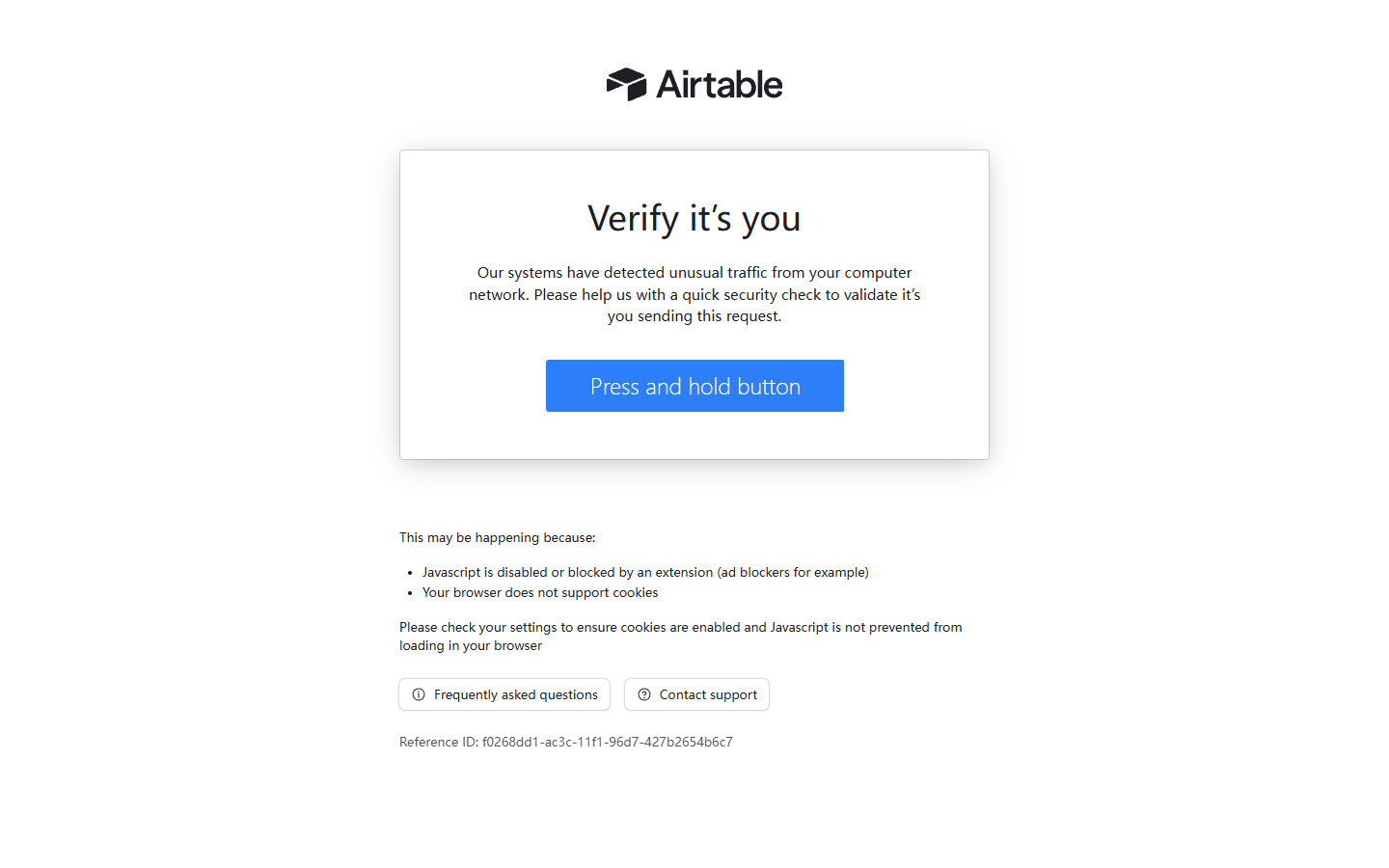
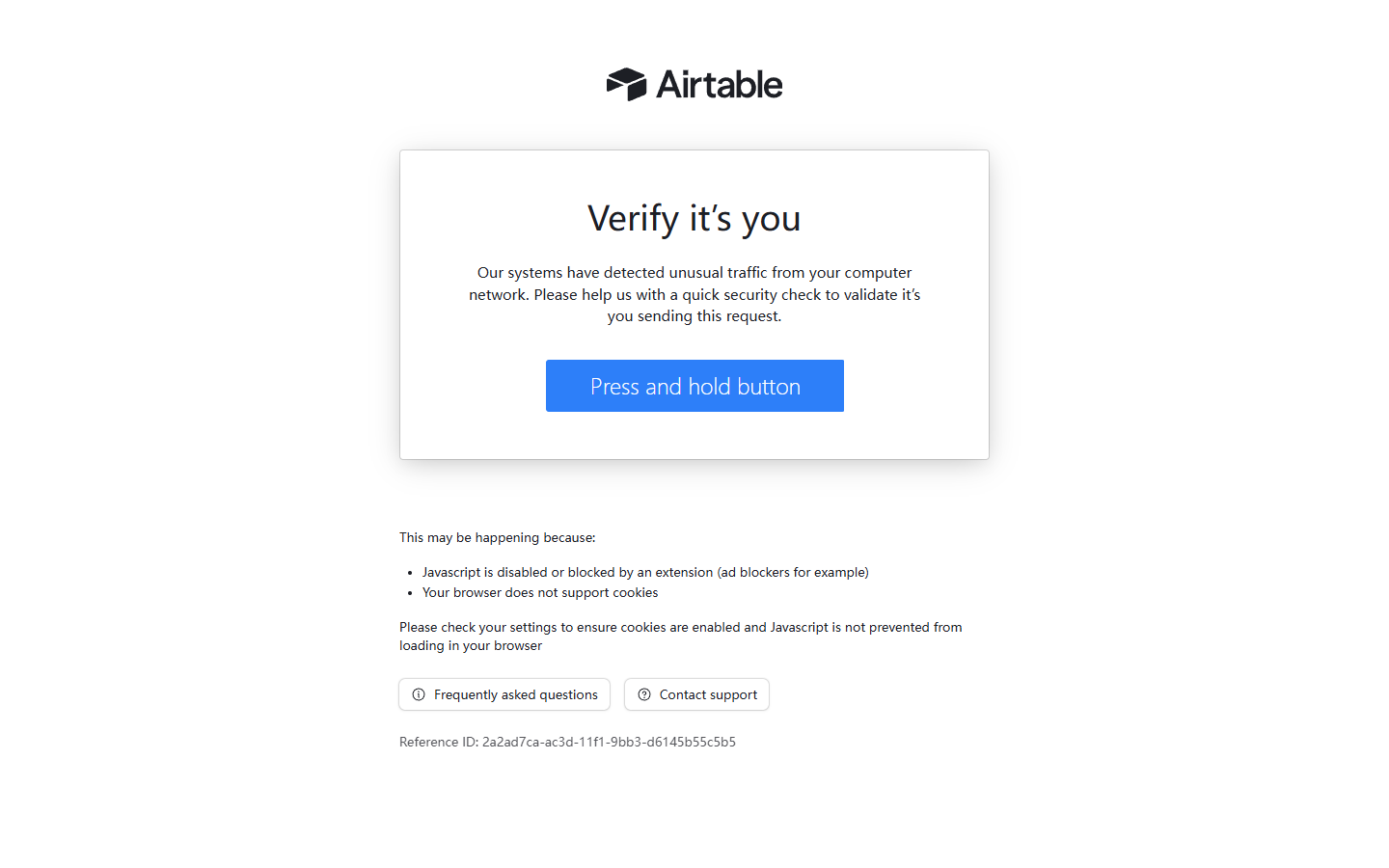
We made two independent attempts to load airtable.com/signup in an automated Chrome session on 2026-09-09, in fresh browser contexts roughly four minutes apart. Both were stopped before any form rendered, by a full-page server-side message:
Verify it’s you — Our systems have detected unusual traffic from your computer network…
Each attempt carried a different reference ID (f0268dd1-… and a second ID on retry), both screenshotted above. This was not a checkbox widget on a signup form — no email field, SSO buttons, or pricing questions ever rendered. It is a reputation-level block, plausibly combining network and automated-browser signals.
What that means for this review:
- We can evidence the pricing page and the wall itself. We cannot evidence which signup methods Airtable currently accepts, whether Free requires a card (the “Try for free” flow suggests not, and third parties agree, but we never saw the form), or its disposable-email policy.
- A person on a residential IP in a normal browser typically will not see this page — the wall is about our probing method, not necessarily your network. If you are evaluating Airtable and hit the same message, switching networks or browsers is the documented-before-it-is-documented workaround.
What we could and couldn’t verify
- Verified on the live page (2026-09-09, re-checked 2026-10-06): all plan prices in both billing modes (zero drift across the 27-day span), the complete Free/Team/Business/Enterprise comparison matrix, AI credit allowances and pack pricing (starting at $20/mo for 10k credits), automation and record ceilings, external email recipients/day limits, and the Portals price inconsistency (three different starting prices for the same 15-guest bundle — $120, $127.50, $150 — quoted verbatim).
- Not verified: signup form contents, credit-card requirements for Free, accepted payment methods, and checkout totals. The signup wall was observed only on 2026-09-09; we did not re-probe it on 2026-10-06, so whether it still returns today is an open question. A third-party claim that self-serve Business/Enterprise purchase requires a private email domain is not printed on the pricing page, so we don’t state it as fact.
- Third-party sources we cross-checked match the official record and API limits; one adds history worth knowing: the Free record cap was lowered from 1,200 to 1,000 in 2023, and the Team plan’s annual rate moved from $10 to $20 — the free tier has been tightening over time.
Bottom line
Airtable Free is a legitimate single-base-scale tool for an individual or a five-editor team, and its editor-only billing keeps read-only collaboration free at every scale. Plan the migration early: 1,000 records and 100 monthly automation runs are the two numbers that end the free-tier experience, and Team at $20/seat/month (annual) is the first step up. Treat the AI credits and Portals add-ons as separate budget lines, and confirm the Portals number in your own checkout — Airtable’s own page can’t decide between $120, $127.50, and $150.
Prices and limits captured from airtable.com/pricing on 2026-09-09 and re-checked 2026-10-06 with zero drift on the price ladder. No Airtable account was created — both 2026-09-09 signup attempts were blocked by the wall documented above; we did not re-probe signup on 2026-10-06. See our testing methodology.
Related pages
Airtable’s seat pricing only makes sense next to its rivals’ notion vs airtable — we priced Notion’s free tier against Airtable’s, record limit by record limit; clickup pricing — ClickUp’s $0 tier and its 60 MB cap, checked the same way; close pricing — Close’s $9–$139 per-user ladder, captured from its own pricing page.